- Home
Edition
Africa Australia Brasil Canada Canada (français) España Europe France Global Indonesia New Zealand United Kingdom United States Skip to content Edition:
Global
Edition:
Global
- Africa
- Australia
- Brasil
- Canada
- Canada (français)
- España
- Europe
- France
- Indonesia
- New Zealand
- United Kingdom
- United States
Academic rigour, journalistic flair
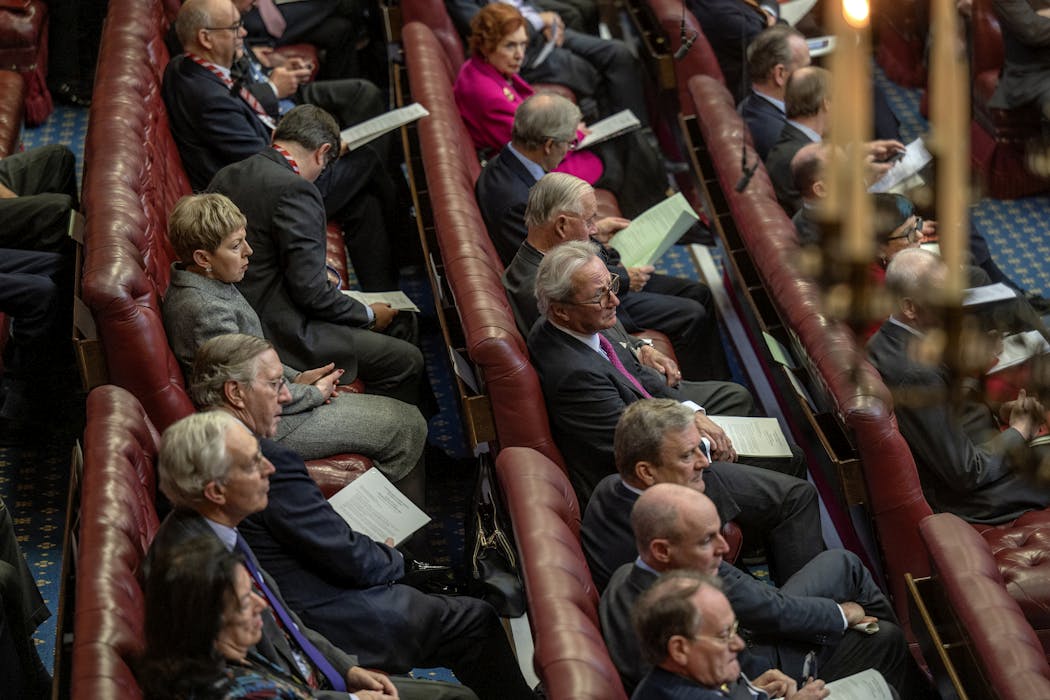
 The House of Lords, October 2025.
© House of Lords 2025/Annabel Moeller/Flickr
The House of Lords has voted to stop under 16s using social media – what happens now?
Published: January 22, 2026 5.54pm GMT
Daniel Gover, Queen Mary University of London
The House of Lords, October 2025.
© House of Lords 2025/Annabel Moeller/Flickr
The House of Lords has voted to stop under 16s using social media – what happens now?
Published: January 22, 2026 5.54pm GMT
Daniel Gover, Queen Mary University of London
Author
-
 Daniel Gover
Senior Lecturer in British Politics, Queen Mary University of London
Disclosure statement
Daniel Gover does not work for, consult, own shares in or receive funding from any company or organisation that would benefit from this article, and has disclosed no relevant affiliations beyond their academic appointment.
Partners

Queen Mary University of London provides funding as a member of The Conversation UK.
View all partners
DOI
https://doi.org/10.64628/AB.dgsqmqdgv
https://theconversation.com/the-house-of-lords-has-voted-to-stop-under-16s-using-social-media-what-happens-now-274139 https://theconversation.com/the-house-of-lords-has-voted-to-stop-under-16s-using-social-media-what-happens-now-274139 Link copied Share articleShare article
Copy link Email Bluesky Facebook WhatsApp Messenger LinkedIn X (Twitter)Print article
The House of Lords has voted, by a significant margin of 261 to 150, to prevent children under 16 in the UK from using social media platforms.
There has been growing political interest in introducing a ban after a similar change came into effect in Australia in late 2025. Around 60 Labour MPs have signed a letter publicly calling for the prime minister to act, while the matter was also raised at prime minister’s questions by the Conservative party leader Kemi Badenoch.
This latest vote in the Lords on January 21 will add momentum to these calls. But how significant is the vote, and how likely is it to ultimately be passed into law?
Wednesday’s vote in the Lords took place on an amendment – that is, a proposed change – put forward to the government’s Children’s Wellbeing and Schools Bill by cross-party peers led by Conservative former minister Lord Nash.
While government ministers opposed Nash’s proposal, and whipped Labour members of the Lords to vote against it, the chamber as a whole opted to back the amendment – producing what is referred to as a government defeat.
Unlike some other votes in parliament, which may be considered non-binding, votes on legislation can present a bigger headache for the government. This is because, if the text in this amendment remained in the bill when it completed its passage and received royal assent, it would become legally binding.
 The Lords’ amendment to the Children’s Wellbeing and Schools Bill would ban social media accounts for under-16s.
Dejan Dundjerski/Shutterstock
The Lords’ amendment to the Children’s Wellbeing and Schools Bill would ban social media accounts for under-16s.
Dejan Dundjerski/Shutterstock
Yet government defeats in the Lords are not unusual, and not necessarily a sign of major trouble. During the 2019-24 parliament, the then Conservative governments suffered over 400 defeats in the Lords – most of them also on amendments to government legislation. Since 2024, under Labour, the number is already well over 100. One reason for this is that, in contrast to the Commons, no party has a majority of seats in the Lords. This means that, if opposition peers are united, governing parties can often be outvoted.
Both Houses must usually agree to a bill in identical form before it can be passed into law. Once both chambers have considered this bill, it will therefore begin a process known as “ping pong”’ – whereby it moves back and forth between the two Houses until all disagreements have been resolved. While in principle the Lords could insist repeatedly on this amendment, it is in practice rare for peers to dig in for long. Members of the Lords often describe their role as being to ask the Commons to “think again”.
The most important actors here are therefore not in the Lords – but MPs in the Commons.
Labour backbench MPs will be key
When the bill later returns to the Commons for the first ping pong stage, MPs will have three options on this amendment: to accept the Lords’ position, reject it outright, or propose an alternative form of words.
The government has a large majority in the Commons, and it is very likely to be able to use this position to get its way on this amendment. Early indications are that ministers intend to ask MPs to reject the amendment. This would effectively delete the proposal from the bill and then send the issue back to the Lords for further consideration.
Yet the prospect of a Commons vote does nonetheless create a problem for the government. This is an issue on which there is known to be widespread disquiet on the Labour benches – almost certainly extending beyond the 60-odd MPs who signed the public letter. Some of these may be reluctant to back down without some sort of concession.
While the government is very unlikely to be defeated in the Commons, this is not necessarily the point. Even the prospect of public dissent can be highly embarrassing, risking perceptions of a divided party unable to command the support of its own backbenchers while also eroding goodwill.
It is for this reason that government ministers are likely to adopt a conciliatory tone when the bill returns to the Commons. It is very unlikely they will accept the Lords amendment outright, but it is possible they may be willing to adopt a compromise form of words – a dynamic that is relatively common in response to Lords defeats.
But it is perhaps even more likely that MPs may be swayed by firm non-legislative commitments by ministers on future action they will take. Indeed, the government has already promised a rapid consultation – announced earlier this week – and this may provide many Labour MPs with the cover they need to back down for now. Others may use the threat of this vote to try to push ministers further, for example by seeking commitments on how the outcome of the consultation will be taken forward.
Taken together, it is very unlikely that the vote in the Lords this week will prove to be the end of the story on this issue. It is quite possible that, by the time the government has finished guiding this bill onto the statute book, this amendment will have been entirely removed. But it may nonetheless have served a large part of its intended purpose by putting pressure on ministers to act.
- Social media
- House of Lords
- Social media ban
- Young people online
Events
Jobs
-
 Lecturer, Nursing
-
Postdoctoral Research Fellow or Research Fellow
-
Lecturer / Sr. Lecturer / A/Professor in Statistics for Omics
-
Lecturer/Senior Lecturer, Terrestrial Ecology
-
Associate Professor/ Professor - Film and Screen
 Lecturer, Nursing
 Postdoctoral Research Fellow or Research Fellow
 Lecturer / Sr. Lecturer / A/Professor in Statistics for Omics
 Lecturer/Senior Lecturer, Terrestrial Ecology
 Associate Professor/ Professor - Film and Screen
- Editorial Policies
- Community standards
- Republishing guidelines
- Analytics
- Our feeds
- Get newsletter
- Who we are
- Our charter
- Our team
- Partners and funders
- Resource for media
- Contact us
-
-
-
-
Copyright © 2010–2026, The Conversation